I couldn't think of a better title for this post than that one simple word.... adversity. If you have ever felt that something was too hard or too difficult, then take the time and watch this short program from ESPN about a couple of High School Students who know something on the subject.
Aug 2, 2009

Jun 29, 2009
GAMES!!! ... and math of course!
I love playing games and what makes one game superior to another, in my mind, is the quality of construction. This 'quality' stems from the balance of elements, one element being strategy. A game that has a discernible optimal strategy is not completely governed by chance (War would be an example of a game that is completely chance, it takes no 'skill' to play because there is no such strategy to help you win [without cheating of course]). However, games with optimal strategies can be 'mastered' or become impossible to succeed without both the time and cognitive ability to dedicate to the game (chess is the perfect example of this type of game). Thus a game that combines both strategy and probability is my kind of perfect game. Well this brought me to love the game of Magic many years ago, this collectible card game [ccg] has been immensely successful in the genre and understandably; it blends the fun elements of a card game with the strategical skill of chess and the element of chance like poker. Here are some links to better inform you of this classic adventure in fun and mathematics (don't worry you might not even see the math at first). The first link describes in more detail the links to the realm of mathematics within the game, the second will introduce you to the game itself and the last to another great blog that details mathematics and gaming.
The Mathematics of Magic: The Gathering
Learning about Magic: The Gathering
A Math/Gaming Blog: Giant Battling Robots
The Mathematics of Magic: The Gathering
Learning about Magic: The Gathering
A Math/Gaming Blog: Giant Battling Robots
May 29, 2009
Math, Gaming, Education, not necessarily in that order
Recently I listened in on a recorded webinar on Classroom 2.0 by Tony Vincent on interactive stories based on the old Choose-Your-Own-Adventure books. Tony is also an expert in technology in the classroom, specifically on hand-held devices. His demonstration on how he incorporated the adventure stories into an English class was very interesting. Students wrote the stories and created elaborate plot lines with alternate endings, this alone caught the interest of many students. However, the class continued to post these stories online using hyperlinks to choose the path of the story instead of flipping through pages like in the old books.
This interactive lesson brought my thinking around to game playing. When students are allowed to make decisions in the class and compete in a game setting, motivation and attention levels skyrocket! I have dabbled in game development for math classrooms, but I have a lot to learn. Giant Battling Robots is a blog that dissects the math intrinsic to many games and discusses both the quality of the game and the mathematics found within. This particular entry does a fantastic job describing Scrabble as a math game more than a word game.
Often I let my natural enthusiasm enhance my lecturing or lesson of the day, just like Robert Ahdoot here:
but game playing is too effective to not put more thought and effort into incorporating into my curriculum.
Anyone have any good ideas about linking High School or Junion High level mathematics to any type of game in a lesson format, please comment or drop me a line, thanks.
This interactive lesson brought my thinking around to game playing. When students are allowed to make decisions in the class and compete in a game setting, motivation and attention levels skyrocket! I have dabbled in game development for math classrooms, but I have a lot to learn. Giant Battling Robots is a blog that dissects the math intrinsic to many games and discusses both the quality of the game and the mathematics found within. This particular entry does a fantastic job describing Scrabble as a math game more than a word game.
Often I let my natural enthusiasm enhance my lecturing or lesson of the day, just like Robert Ahdoot here:
but game playing is too effective to not put more thought and effort into incorporating into my curriculum.
Anyone have any good ideas about linking High School or Junion High level mathematics to any type of game in a lesson format, please comment or drop me a line, thanks.
May 28, 2009
Update + Matrix Operations
As you could have noticed by some references below I've been into matrix operations lately. Two reasons have pushed my interest in this 1: I'll be student teaching in August at a local High School and this is a subject I'm going to be teaching, and 2: (and this is probably more influential at the moment) this is my theme unit for my Education Technology and Design class I'm currently taking this summer. (BTW, this is the last class I'll ever have to take!!! Woot!) (...well, besides grad school someday...)
So, I have been doing a lot of research and spending a lot of time and energy into learning different ways to teach matrix operations (addition, subtraction, and multiplication) and specifically how to better use technology in my instruction. I have to admit, I've learned a lot of cool websites lately and even learned to use some nice software (evidence of that can be seen here), but my favorite by product of new knowledge has so far been connecting the way I interact and socialize electronically to how I can interact with my students. Blogging obviously can be applied as a classroom resource, shared documents and wiki's, twitter, and even social networking can all be incorporated into a learning environment.
So, I have been doing a lot of research and spending a lot of time and energy into learning different ways to teach matrix operations (addition, subtraction, and multiplication) and specifically how to better use technology in my instruction. I have to admit, I've learned a lot of cool websites lately and even learned to use some nice software (evidence of that can be seen here), but my favorite by product of new knowledge has so far been connecting the way I interact and socialize electronically to how I can interact with my students. Blogging obviously can be applied as a classroom resource, shared documents and wiki's, twitter, and even social networking can all be incorporated into a learning environment.
May 20, 2009
WebQuest on eyelearnmath.blogspot.com
Check out my new entry on my alternate blog on teaching math.
I discuss my new Webquest and additional information on matrix operations and applications.
I discuss my new Webquest and additional information on matrix operations and applications.
May 17, 2009
Mathematics Education: Matrix Operations Interactive Worksheet

This post is from my mathematics education blog located at: eyelearnmath.blogspot.com
Strength comes with diversity and when addressing the issue of instructional media, diversity provides strength in optimizing student interest and involvement. Traditional lectures have a well-deserved important place in the classroom, however, providing alternative modes of instruction and classroom interaction. Non-traditional or alternate modes of instruction can meet many different INTASC standards such as 4, 5, and 6. Here are a list of those standards and how they may apply to the Inspiration interactive worksheet I developed and posted above.
STANDARD 4: MULTIPLE INSTRUCTIONAL STRATEGIES
The teacher understands and uses a variety of instructional strategies to encourage student development of critical thinking, problem solving, and performance skills.
Obviously alternative instructional media, such as Inspiration worksheets relate to 'a variety of instructional strategies to encourage student development.' The challenge that lies within is addressing 'critical thinking, problem solving, and performance skills.' My worksheet combines interactive technology along with problem solving skills while requiring subject knowledge.
STANDARD 5: MOTIVATION AND MANAGEMENT
The teacher uses an understanding of individual and group motivation and behavior to create a learning environment that encourages positive social interaction, active engagement in learning, and self-motivation.
Interactive worksheets create motivation strictly from the process of its own interaction, however the quality of that interactivity is key to promoting quality motivation. The degree of diversity can increase the effectiveness of individual instruction as well.
STANDARD 6: COMMUNICATION AND TECHNOLOGY
The teacher uses knowledge of effective verbal, nonverbal, and media communication techniques to foster active inquiry, collaboration, and supportive interaction in the classroom.
Communication's effectiveness is also strengthened through diversity. The worksheet above allows students to visualize a previous lesson on matrix operations and connect ideas with an interactive interface. Using technology in the classroom not only provides a diverse instructional medium, increase motivation but also helps teach skills needed beyond the classroom.
These standards are also illustrated here in Robert Ahdoot's webcasts of his classroom instruction. By introducing webcasts, Robert adds excitement to an already energetic lesson and also allows students a very practical mode of reviewing instruction.
Dec 30, 2008
A New Direction: Changing Conflict Resolution in the Middle East - A Three Act Proposal
Act I: Revisiting the Past
Certain patterns in the realm of terrorism and especially the response to terrorism have been emerging in the past decade, if not longer. I want to make clear that under no circumstances would I suggest a lack of response to typical terror attacks, or significant threats of violence, but I do want to take a critical look at the recent responses by powerful governments to the aggressions of smaller and often stateless religiously and socially motivated entities. Observably, the beliefs that large military showings do not, under any circumstances, discourage those who wish to seek antagonistic retribution or aggressions. A classic example of this initiative to overpower or appear to overpower an enemy and to dishearten and dismay their future plans, is the attempt of the ‘shock and awe’ campaign by the US at the beginning of the invasion of Iraq.
It is clear that the fervor of any ‘insurgents’ was not thwarted or crushed, in fact it is widely accepted that the large military presence in Iraq is exactly what brought these terrorists or insurgents to the area as a reaction to US aggression, not preceding it. So fundamentally, the campaign was meant to scare any would-be insurgents into submission, or at least suppress their will to fight, but alternatively it was a rallying cry, not just for anti-American militarists, but for thousands of Arabs and Muslims who believe in an autonomous state in Iraq, one free of Western control.
I am also not taking responsibility or claiming justification for militant Islamic fundamentalists who use violence to suppress others and force their will on the people, even when claiming the aggressions of others as their motivation. These groups are unquestionably responsible for their own violence and hostility, provoked or not, and are unjustified to coerce and terrorize in the name of peace. However, this behavior to some degree is learned, and we, more often than not, are the teacher. The recent attacks on Mumbai demonstrates my point; the regime responsible for the attacks, the Lashkar-e-Taiba, was trained by US special forces during the Russian conflict in Afghanistan during the mid to late 80’s.
Successfully equipped and trained to defeat the Soviets, groups like Lashkar-e-Taiba had little to do constructively after the conflict. The void of power created struggles and a need for tribal armies and other conflicts involving Muslim people also perpetuated the need for such groups. Seeing all Western influence as a hindrance to Muslim peoples, many militant groups took up arms against the entirety of the Western world. Often these perspectives were correct, US and European influence has scarcely been a long-term positive interaction in the Middle East. The training of Lashkar-e-Taiba is a classic example; we train the indigenous people to create conflict but not how to build a school or maintain infrastructure. Iraq has been a second illustration of this pattern. Even in the creation of Middle Eastern nations, after the devastation of World War I and II, the Western powers divided up the land as if it were a bounty of war; this is exactly how Iraq itself was formed.
Act II: Source of the Conflict
Enter into the equation Israel and their current war with Hamas and it is no wonder why the region is maintaining its status at a boiling point. My attempt at a brief historical context was meant to make this point: violence begets violence and one can no longer be used to justify the other. After creating many of the conditions in which the real victims, the citizens and common people of the land, suffer under the control of the only leaders capable of sustaining power, the US and allies shrug our shoulders at the motivations of such people. Our own naiveté toward our responsibility in causing strife and pushing militaries without pushing schools and hospitals is laughable.
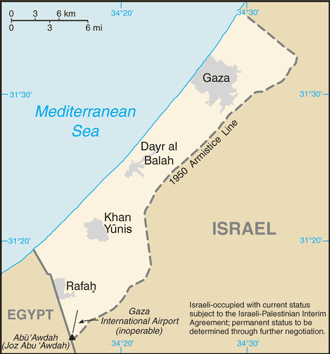
Now Israel is struggling with very similar problems, but for them it is within its own borders. The Israeli people are certainly victims themselves. Rocket and mortar attacks by Hamas can in no way be tolerated. However, leveling the Palestinians infrastructure is hardly an effective response to this violence. In fact, responding to intolerable violence with intolerable violence is self-perpetuating. The Israeli military is attempting to bomb as accurately as they can and are targeting government (Hamas) and military targets, but a little info on the Gaza Strip is needed here.
A 360 square mile stretch of coastal land located between southern Israel and Egypt, this Palestinian territory has been under Israeli control since 1967 after invasion forced Egyptian forces out. It has a population of over 1.5 million, which means there are well over 10,000 people for every square mile, hardly optimal conditions for military air strikes, no matter how precise. Therefore civilian casualties are inevitable. So how do Israeli leaders expect that attacking these targets this way will lead to an end of violence? How can they expect the Palestinian people to choose peace when they themselves are making the opposite choice? The same can be said of Hamas, however their goals are different than the Israelis.
Hamas is no victim, they have conducted as much warfare as anyone involved and they have purposefully targeted civilians. So the problem is, how does Israel protect itself from attacks stemming from a group that has won the respect of its citizens by providing the services Israel had not, namely schools, hospitals and other services? This same group now hides among the people who elected them. Israel’s response is to pressure the Palestinians with military might into rejected Hamas and casting them out. But as we’ve already discussed, this bullying tactic has shown grossly ineffective. Instead of surrendering to pressure, the Palestinians will do what they have for decades now, and harden their resolve.
Act III: A New Hope
If Israelis wish to persuade the people of Palestine, they need to only look to those who have won their favor. By giving the people what they need, Israel can change the course of their contention in time. Providing a safe, and violence free environment for their rivals is the direction needed to reach what the Israeli people want for themselves.
This same general concept should undoubtedly be applied to most of the Western world and it’s contentions with Middle Eastern establishments. The needs of the people are creating the environment for militaristic regimes to maintain power. They supply minimal amounts of necessities for the populations and in return influence the political atmosphere and impose their own agendas. If we wish to create political change, then the source of basic needs of the people must first change. The days of fighting fire with fire has only left us burnt in the end, looking forward we need a new solution, a solution based on rational decision and a critical analysis of the past.
Certain patterns in the realm of terrorism and especially the response to terrorism have been emerging in the past decade, if not longer. I want to make clear that under no circumstances would I suggest a lack of response to typical terror attacks, or significant threats of violence, but I do want to take a critical look at the recent responses by powerful governments to the aggressions of smaller and often stateless religiously and socially motivated entities. Observably, the beliefs that large military showings do not, under any circumstances, discourage those who wish to seek antagonistic retribution or aggressions. A classic example of this initiative to overpower or appear to overpower an enemy and to dishearten and dismay their future plans, is the attempt of the ‘shock and awe’ campaign by the US at the beginning of the invasion of Iraq.
It is clear that the fervor of any ‘insurgents’ was not thwarted or crushed, in fact it is widely accepted that the large military presence in Iraq is exactly what brought these terrorists or insurgents to the area as a reaction to US aggression, not preceding it. So fundamentally, the campaign was meant to scare any would-be insurgents into submission, or at least suppress their will to fight, but alternatively it was a rallying cry, not just for anti-American militarists, but for thousands of Arabs and Muslims who believe in an autonomous state in Iraq, one free of Western control.
I am also not taking responsibility or claiming justification for militant Islamic fundamentalists who use violence to suppress others and force their will on the people, even when claiming the aggressions of others as their motivation. These groups are unquestionably responsible for their own violence and hostility, provoked or not, and are unjustified to coerce and terrorize in the name of peace. However, this behavior to some degree is learned, and we, more often than not, are the teacher. The recent attacks on Mumbai demonstrates my point; the regime responsible for the attacks, the Lashkar-e-Taiba, was trained by US special forces during the Russian conflict in Afghanistan during the mid to late 80’s.
Successfully equipped and trained to defeat the Soviets, groups like Lashkar-e-Taiba had little to do constructively after the conflict. The void of power created struggles and a need for tribal armies and other conflicts involving Muslim people also perpetuated the need for such groups. Seeing all Western influence as a hindrance to Muslim peoples, many militant groups took up arms against the entirety of the Western world. Often these perspectives were correct, US and European influence has scarcely been a long-term positive interaction in the Middle East. The training of Lashkar-e-Taiba is a classic example; we train the indigenous people to create conflict but not how to build a school or maintain infrastructure. Iraq has been a second illustration of this pattern. Even in the creation of Middle Eastern nations, after the devastation of World War I and II, the Western powers divided up the land as if it were a bounty of war; this is exactly how Iraq itself was formed.
Act II: Source of the Conflict
Enter into the equation Israel and their current war with Hamas and it is no wonder why the region is maintaining its status at a boiling point. My attempt at a brief historical context was meant to make this point: violence begets violence and one can no longer be used to justify the other. After creating many of the conditions in which the real victims, the citizens and common people of the land, suffer under the control of the only leaders capable of sustaining power, the US and allies shrug our shoulders at the motivations of such people. Our own naiveté toward our responsibility in causing strife and pushing militaries without pushing schools and hospitals is laughable.
Now Israel is struggling with very similar problems, but for them it is within its own borders. The Israeli people are certainly victims themselves. Rocket and mortar attacks by Hamas can in no way be tolerated. However, leveling the Palestinians infrastructure is hardly an effective response to this violence. In fact, responding to intolerable violence with intolerable violence is self-perpetuating. The Israeli military is attempting to bomb as accurately as they can and are targeting government (Hamas) and military targets, but a little info on the Gaza Strip is needed here.
A 360 square mile stretch of coastal land located between southern Israel and Egypt, this Palestinian territory has been under Israeli control since 1967 after invasion forced Egyptian forces out. It has a population of over 1.5 million, which means there are well over 10,000 people for every square mile, hardly optimal conditions for military air strikes, no matter how precise. Therefore civilian casualties are inevitable. So how do Israeli leaders expect that attacking these targets this way will lead to an end of violence? How can they expect the Palestinian people to choose peace when they themselves are making the opposite choice? The same can be said of Hamas, however their goals are different than the Israelis.
Hamas is no victim, they have conducted as much warfare as anyone involved and they have purposefully targeted civilians. So the problem is, how does Israel protect itself from attacks stemming from a group that has won the respect of its citizens by providing the services Israel had not, namely schools, hospitals and other services? This same group now hides among the people who elected them. Israel’s response is to pressure the Palestinians with military might into rejected Hamas and casting them out. But as we’ve already discussed, this bullying tactic has shown grossly ineffective. Instead of surrendering to pressure, the Palestinians will do what they have for decades now, and harden their resolve.
Act III: A New Hope
If Israelis wish to persuade the people of Palestine, they need to only look to those who have won their favor. By giving the people what they need, Israel can change the course of their contention in time. Providing a safe, and violence free environment for their rivals is the direction needed to reach what the Israeli people want for themselves.
This same general concept should undoubtedly be applied to most of the Western world and it’s contentions with Middle Eastern establishments. The needs of the people are creating the environment for militaristic regimes to maintain power. They supply minimal amounts of necessities for the populations and in return influence the political atmosphere and impose their own agendas. If we wish to create political change, then the source of basic needs of the people must first change. The days of fighting fire with fire has only left us burnt in the end, looking forward we need a new solution, a solution based on rational decision and a critical analysis of the past.
Subscribe to:
Comments (Atom)